The Clock in the Machine
Welcome back, and a warm hello to the newcomers. Fair warning before we start: this is a long one. I had a lot rattling around in my head this week and not much willpower to cut it down. So put your doom-scrolling thumb away for a few minutes, settle in like it's a Sunday paper, and bear with me. I promise you will walk away knowing something you did not know this morning, and it is genuinely one of the coolest things I have learned all year.
Quick housekeeping before the main event.
First, a Word About Fable
Last week (Once Upon a Model) I told you all about Claude Fable 5, the new frontier model, and the free window to try it. Well. That window slammed shut faster than any of us expected, and not on its own. Regulators stepped in. The public version got switched off, and Fable-class models are now behind a government approval gate, the same kind of "by permission only" treatment its locked twin Mythos already had.
I am not going to do a whole autopsy here, because honestly the dust is still settling and I would rather tell you what's true than what's loud. The short version: the thing I flagged last week, that the most capable AI was quietly splitting into a "public" tier and an "only-if-we-say-so" tier, happened even faster and harder than I guessed. The public just got moved to the far side of that line. We will come back to this once the story is actually finished and not just trending. For now, file it under "told you to sit with that one."
Okay. Deep breath. On to the good stuff.
The One AI We Actually Understand
Here is a fact that should bother you more than it does: nobody really knows how AI works. I do not mean that in a spooky marketing way. I mean it literally. When ChatGPT writes you a sentence, that sentence is the result of hundreds of billions of tiny calculations, and even the people who built it cannot point to where, exactly, the "knowing" lives. We grew these things by feeding them the entire internet and rewarding them for guessing the next word, over and over, trillions of times, and somewhere in all that guessing, something that looks an awful lot like understanding showed up. We just cannot fully explain how.
So this week I watched a wonderful video by a channel called Welch Labs that asks a sneaky little question: how simple do we have to make an AI before we can completely understand it, every gear and lever, no mystery left? And the answer turns out to be one of the most charming stories in all of modern science. Stick with me, because the payoff is worth it.
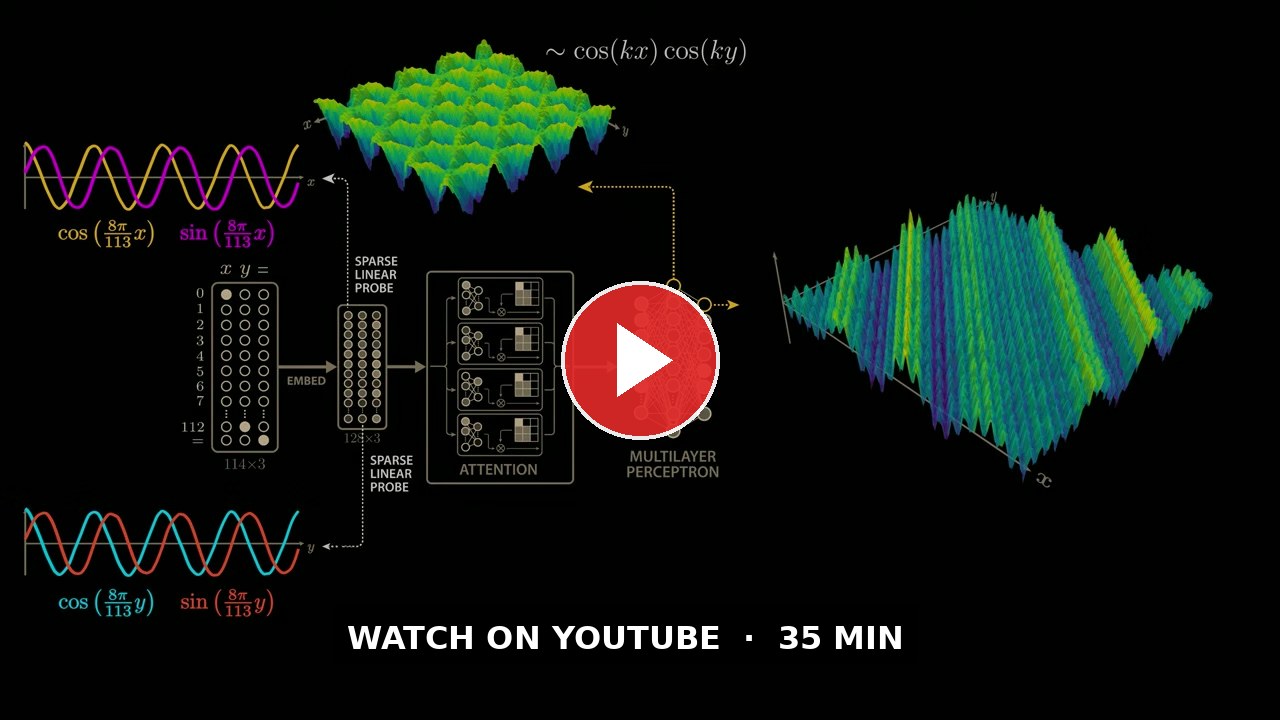
The video we're breaking down: "The most complex model we actually understand" by Welch Labs (about 35 minutes, and worth every one). Click the image to watch it.
Memorizing Versus Actually Getting It
You already know the difference between memorizing and understanding, you just know it from grade school. A kid can memorize that seven times eight is fifty-six without having the faintest idea what multiplication is. They have the answer to that one question, but ask them something slightly different and they are stuck. Then one day, often after a frustrating stretch where it seems like nothing is sinking in, the actual idea clicks. Suddenly they can multiply numbers they have never seen before. They did not memorize more. They finally understood.
It turns out AI does this too, and watching it happen is the whole story. Researchers gave a very small AI a simple math task and watched it learn. Here is what they saw, and it is genuinely strange.
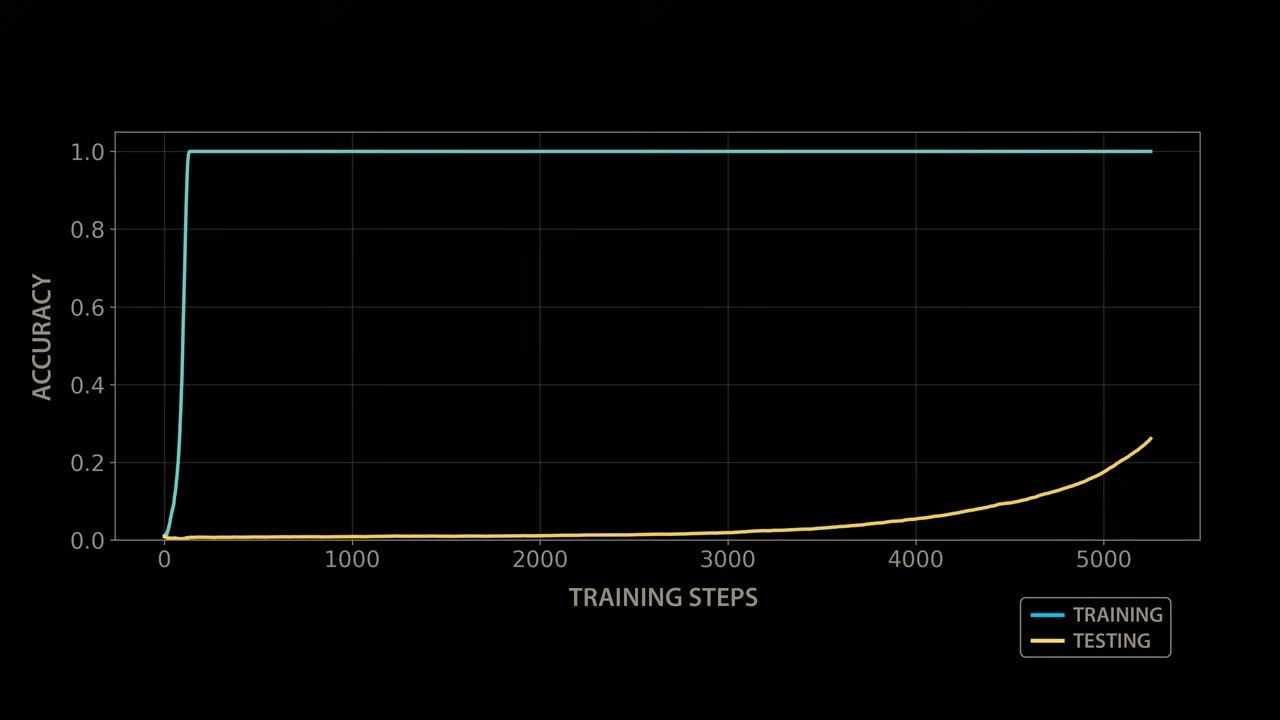
The blue line is the AI on questions it has already seen (memorizing). It nails those almost instantly. The yellow line is the AI on brand-new questions (actually understanding). It stays flat near zero for a long time, then slowly climbs. That gap is the whole mystery.
Look at that yellow line. For thousands of rounds of practice, the AI looks completely stuck. It has perfectly memorized its homework (blue line, pinned at the top) but it is hopeless on anything new (yellow line, flat on the floor). Any sane person watching would say "well, it's done, it learned what it could, time to give up." And then, long after you would have quit, the yellow line peels off the floor and climbs, and the AI suddenly gets it. It can now solve problems it was never shown.
This delayed, out-of-nowhere click has a name, and it is a wonderful one: grokking. We will get to where that word comes from, because it is a story in itself.
The Part That Made Me Sit Up
Here is where it goes from "neat" to "wait, what?" Because the small size of this AI meant the researchers could pop the hood and look at exactly what it built inside itself during that long flat stretch. What was it doing all that time while it looked stuck?
The task, by the way, was clock math. Not the words "clock math," but that is what it is. Think about it: if a two-hour meeting starts at eleven, it ends at one, not at thirteen. You wrapped around. That is the kind of math a clock does, counting forward and then starting over at the top. The little AI was learning to do exactly this, the wrap-around arithmetic of a clock face.
And when the researchers looked inside, they found that the AI had secretly built itself a clock. Not because anyone told it to. It discovered, entirely on its own, that the natural way to do wrap-around math is to think in circles, and it started representing numbers as positions around a circle, using the mathematics of waves and curves. Sine waves. Cosines. The exact stuff your kids groan about in high school trigonometry. Nobody put trig in there. The AI reinvented it from scratch because a circle is simply the right tool for the job, and it figured that out by itself.
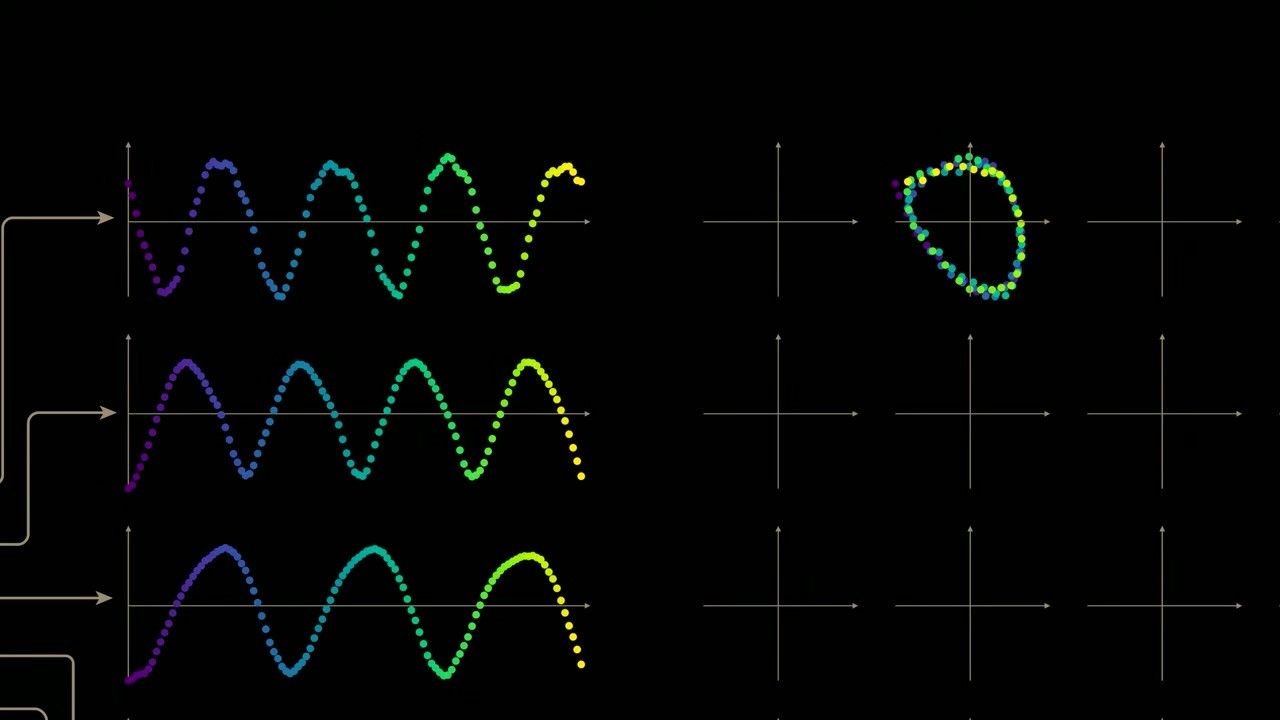
Real signals pulled out of the AI's insides. Those smooth waves on the left fold together into a perfect loop on the right. That loop is the clock it built for itself, with no one teaching it how.
This is the colorful mess in that first picture up top, by the way. All those green and blue ripples are not decoration. They are the wave patterns the AI invented and then layered together to actually do the math. And the reason the yellow line stayed flat for so long is that building this internal clock takes time. The AI was not stuck during that plateau. It was quietly constructing trigonometry in private, piece by piece, and only once the clock was finished and it threw away its memorized cheat sheet did the understanding suddenly show up on the outside. The "aha" was being assembled the whole time. We just could not see it from the scoreboard.
Why This Little Story Matters
You might be thinking, fine, one tiny AI taught itself to read a clock, cute. But here is why researchers care so much. This is one of the only times, maybe the only clean time, that we have been able to open up an AI and understand completely how it does what it does, every step, no hand-waving. Usually these systems are black boxes. We can see what goes in and what comes out, but the middle is a fog. This time the fog cleared, and inside was a clockmaker. A transparent box in a world of black boxes, as the video nicely puts it.
The field that does this, prying open AIs to read their actual machinery, is called mechanistic interpretability, which is a mouthful that just means "figuring out the mechanism." And it is not only toy AIs. The team at Anthropic (the folks behind Claude, who you have heard me go on about) used the same detective work on a real, full-size model to figure out how it decides when to start a new line while it writes. Turns out it keeps a kind of internal tape measure running, sensing how close it is to the edge of the line. Same flavor of hidden structure, just in something far bigger. We are nowhere near understanding a whole large model this cleanly yet, but the clock-reading AI is the proof that it is even possible. That is a big deal.
Where the Funny Word Comes From
I promised you the word. Grok was invented by a science-fiction writer named Robert Heinlein in a 1961 novel. In the book it is a word from Mars, and it means to understand something so deeply and completely that you almost merge with it. Not "I read about it." More like "it is now part of me." Which is a pretty perfect name for what that AI did. It did not memorize the clock. It became the clock.
And I will leave you on the thought the video ends on, because it has been knocking around my head all week. A well-known AI researcher named Andrej Karpathy said that training these models is less like building an animal's mind and more like "summoning ghosts." We talk to them in plain English, so it is easy to imagine there is a little person in there. But when you go one layer down, past the friendly words, you do not find a person. You find these absurd, beautiful, alien patterns, like a homemade clock built out of waves. They are not human minds. They are something genuinely new, wearing a human-language costume. The more we learn about how they actually work under the hood, the more I think that costume is very, very thin.
Below the fold this week: a quick look at the thing I built for a hackathon, and a genuinely useful (and slightly dangerous) trick for anyone using Claude Code.
Until next week,
| ◆ Below the fold ◆ |
What I Built: Forum
I spent last week heads-down on a hackathon entry, and I want to show it to you. It is called Forum, and the one-line pitch is this: it tells you where your team really stands before the meeting, not during it.
Here is the idea. Instead of everyone walking into a room and discovering halfway through that two departments completely disagree, a little team of AI agents goes around and "interviews" each person ahead of time. Then those agents hash out the disagreements among themselves, and hand you a single page that says: here is what everyone actually thinks, here is where they clash, here is what is still unknown. You walk in already knowing where the landmines are. The fun technical part, and the part the hackathon was really about, is that the AI agents negotiate with each other out loud, instead of one lone AI quietly making it all up.
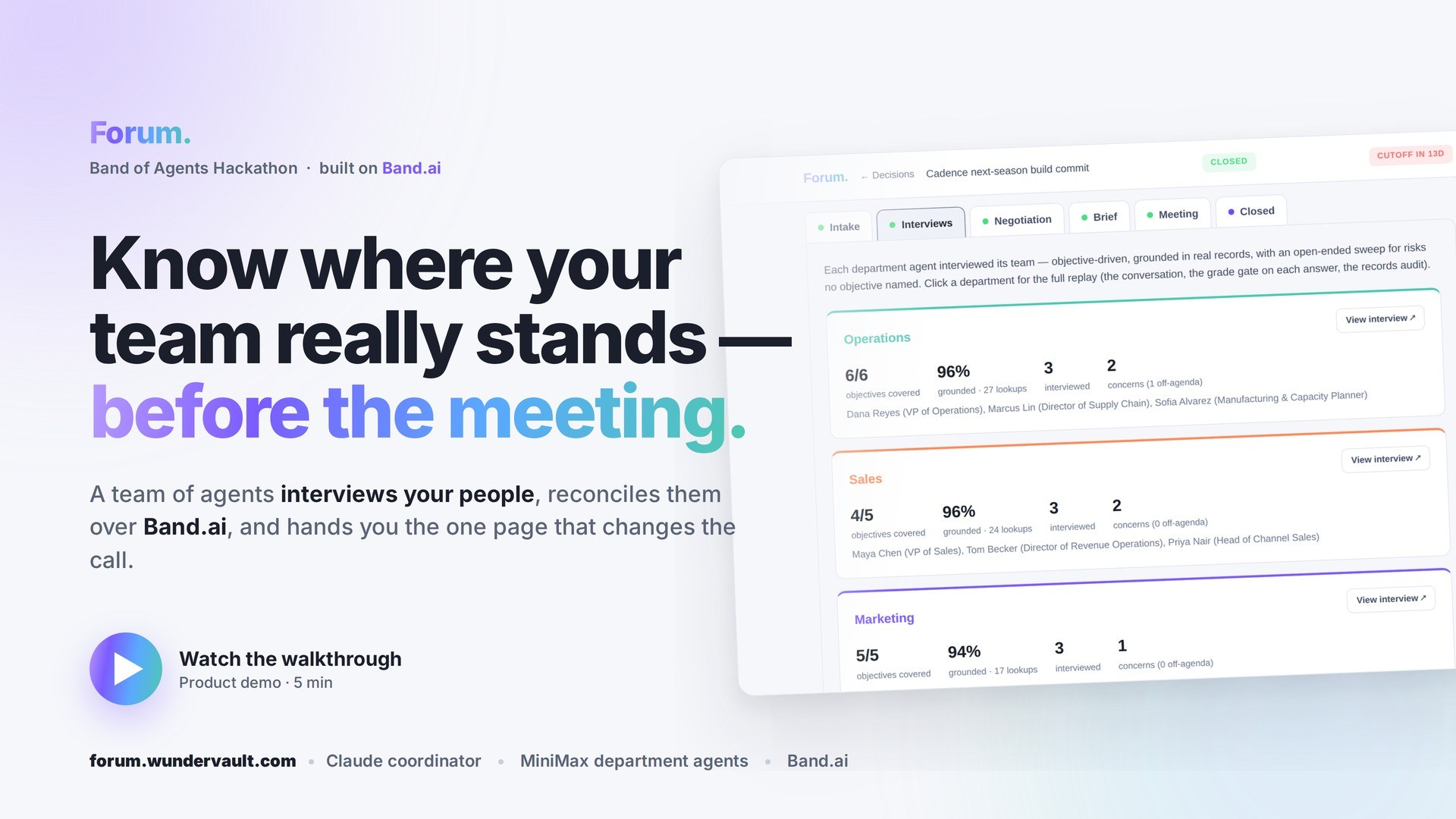
Click to watch the five-minute walkthrough. You can also try Forum yourself at forum.wundervault.com.
If you want to poke at it, the live version is at forum.wundervault.com. I would love to hear what you think, especially if you have ever sat through a meeting that could have been a one-page summary.
A Trick for the Builders: Bypass Permissions
This one is for anyone running Claude Code, the coding assistant I keep nudging you toward. Normally, every time Claude wants to do something on your computer (edit a file, run a command) it stops and asks your permission first. Which is safe and sensible, and also, after the four-hundredth "can I? can I? can I?" of the day, makes you want to throw your laptop into the sea.
There is a mode that turns the asking off. Claude just goes and does the work, start to finish, without stopping to check with you on every little step. It is the closest thing to handing the keys over and letting it drive. To switch it on, you start Claude Code with this:
claude --dangerously-skip-permissions
Yes, they really named the flag "dangerously," and yes, you should take that seriously. This is the digital equivalent of letting someone reorganize your entire kitchen while you nap. Usually you wake up to a beautifully sorted kitchen. Occasionally you wake up to find the good china in the garbage. Do this at your own risk, ideally only on a project where nothing catastrophic can happen if the assistant gets a little too enthusiastic, and never point it at anything you cannot afford to lose. With that said, for grinding through a big pile of safe, repetitive work while you go make coffee, it is glorious.

If you grew up on The Simpsons: it is the drinking-bird-pecking-the-Y-key approach to work. Set it going, walk away, hope for the best.
That is the whole trick. One flag, a lot of saved clicks, and a healthy respect for the word "dangerously." Try it on something low-stakes first and you will quickly learn how much rope you are comfortable giving it.
Thanks for reading all the way down here, truly. I know that was a long one. Send me your AI questions, tell me what you grokked this week, and I will see you next Saturday.
"How long is forever?" said Alice. "Sometimes, just one second," said the White Rabbit.
— Alice in Wonderland